
Polarised Fishing Sunglasses — Lens Colour, Light and Fit
( number of products: 30 )Polarised fishing sunglasses reduce glare reflected from the water, making currents, obstructions, bottom structure and fish easier to observe when water clarity and light allow. Polarisation cannot remove every reflection or make rough, coloured or turbid water transparent.
The main choice is lens tint and light transmission: yellow supports vision in shade and low light, copper or brown adds contrast in variable conditions, and grey controls brightness in strong sun. UV protection, frame fit and compatibility with prescription spectacles must be checked separately.


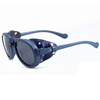
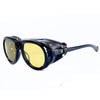


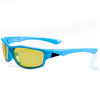
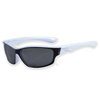


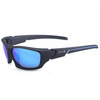
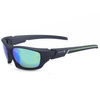
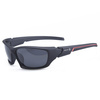


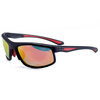
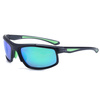
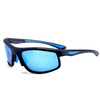
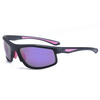
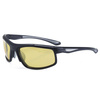


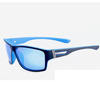
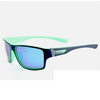


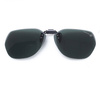
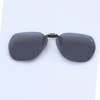
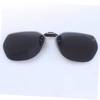


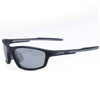
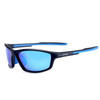


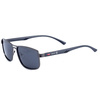
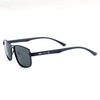
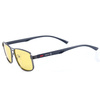


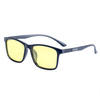
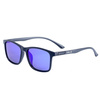


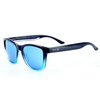
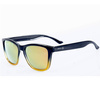
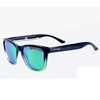
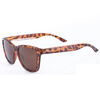
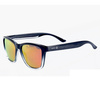


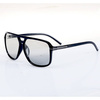
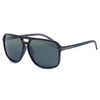
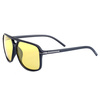
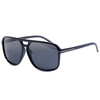


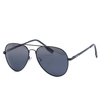
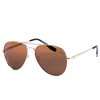


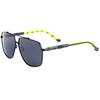
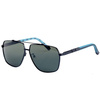
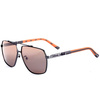
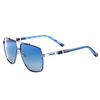


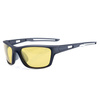
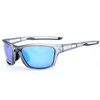
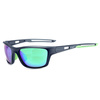


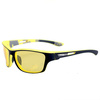
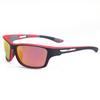
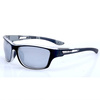
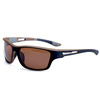
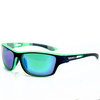
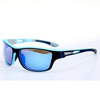


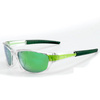
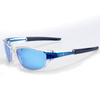


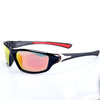
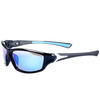
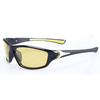


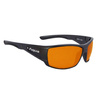
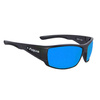


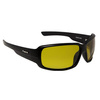
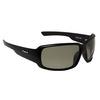
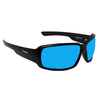
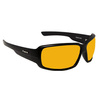


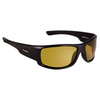


How does polarisation work around water?
Light reflected from a flat water surface contains a strong horizontally orientated component. A correctly aligned polarising filter reduces that light, cutting the white sheen and mirror-like reflections. In practice, it improves surface contrast and can make detail below the surface easier to read.
The effect changes with viewing angle, sun position, waves, water colour and clarity. The greatest difference is often seen when light is reflected at an angle. Looking almost vertically into rough or turbid water, even a good lens cannot reveal detail that the available light does not carry.
Polarisation is useful for more than spotting fish. It can help with reading depth changes, locating stones and weed while wading, following the fly line and seeing subtle surface movement. Caution is still required: the view through a lens is not a depth measurement, and refraction changes the apparent position of objects below water.
Lens colour for different fishing conditions
| Lens colour | Most useful conditions | What to consider |
|---|---|---|
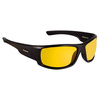
| Yellow | Dawn, dusk, deep shade, wooded streams and overcast days | Transmits plenty of visible light and increases perceived contrast; it may be too bright in full sun. |
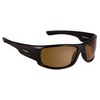
| Copper, amber or brown | Mixed light, broken cloud and rivers with varied backgrounds | Strengthens contrast between stones, weed and silhouettes, while altering colour perception. |
| Grey | Strong sun, open rivers, lakes and prolonged use in bright surroundings | Reduces overall brightness with relatively neutral colour rendering; it can be too dark in shade. |
| Mirror coating | Very bright, open water and prolonged exposure to intense light | The mirror colour describes the outer coating; the view through the glasses also depends on the underlying lens tint. |
No single tint is right for an entire day in all conditions. An angler moving between shade and open water may favour copper or a photochromic lens. Where conditions are extreme, two pairs or interchangeable lenses offer greater control than one dark tint worn from first light to dusk.
Polarisation, tint and UV protection are different
Polarisation reduces a particular orientation of reflected light. Tint controls the quantity and spectrum of visible light reaching the eye. UV protection attenuates ultraviolet radiation. A dark lens is not automatically polarised and does not by itself confirm UV protection.
Check the exact variant for a UV400 or 100% UV protection declaration. Aqua states that its fishing lenses provide complete UV protection, but that claim must not be transferred automatically to another brand or to an unlabelled lens.
Fishing sunglasses also form a physical barrier against wind, insects, branches and a moving fly. They are not industrial safety glasses or guaranteed protection against every impact unless the exact model carries an appropriate standard.
Aqua PL, PPX and Polarchromic lenses
Aqua PL polarised lenses are made from flat TAC sheet. Aqua describes them as light, with a surface treatment intended to improve scratch resistance. Different PL colours suit different light; the PL name does not indicate one fixed level of darkness.
Aqua PPX is a polymer lens family developed around optical performance, mechanical resistance and stability. Scratch-resistant does not mean scratch-proof: sand, salt and wiping a dirty lens can still damage its surface.
Aqua Polarchromic combines polarisation with a photochromic response. The lens changes light transmission in response to outdoor conditions; Aqua states that maximum absorption is reached after about 30 seconds in sunlight. The response is not an instant switch, and the available range depends on the exact variant.
Photochromic or fixed-tint lenses?
A photochromic lens is useful when light changes during a walk, between wooded banks and open river, or as cloud cover develops. It can reduce the need to swap glasses, but requires time to respond and may not reach the same darkness under every condition.
A fixed tint gives a predictable view. Yellow stays bright in shade, grey controls intense light, and copper retains its characteristic contrast enhancement. If most fishing takes place in one type of light, a well-chosen fixed tint may be the simpler answer.
Frame fit and side coverage
Fit matters as much as the lens. Glasses should remain stable when bending down, avoid pressure at the temples and sit clear of the eyelashes. The bridge and nose pads must position the lenses in front of the eyes without sliding on damp skin.
A wraparound frame and broad temples reduce stray side light, helping the polarising lens work in bright surroundings. A very close fit can reduce ventilation, however. Check whether the lens fogs excessively during a strenuous walk, in high humidity or when worn with a face covering.
Manufacturer dimensions commonly include lens width and height, bridge width and temple length. They help compare models but cannot fully describe head shape. Base curve 8 or 9 indicates a strongly curved sports form; it is not a lens size.
Fit-over, clip-on and flip-up options
Fit-over eyewear is worn over prescription spectacles. Compare its internal width, height and temple clearance with your own frame. The fit-over description does not imply compatibility with every pair of spectacles.
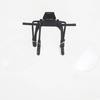
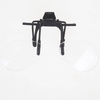
A clip-on attaches a polarised lens to a prescription frame, while a flip-up can be raised without removing the spectacles. Check width, shape, weight and the contact point of the mounting mechanism. An undersized attachment restricts the field of view; an oversized one may foul the frame or cheeks.
Reader attachments provide close-up magnification for tying on a fly or changing tippet. Choose the power for your own near-vision needs. They do not replace an eye examination or individually prescribed correction.
What should you check before fishing?
- Stability: lower your head and make a casting-like movement. The frame should not slip or bounce.
- Field of view: confirm that the frame or clip-on edge does not obscure the area used to watch the line and water.
- Side light: assess gaps at the temples and cheeks. Strong internal reflections can reduce comfort despite a good lens.
- Optical quality: view a straight vertical edge and move your head. The line should not wave or change shape noticeably.
- Labelling: verify polarisation, UV protection, base tint and any restrictions stated for the exact variant.
Cleaning and storage
Rinse away sand, dust or salt with clean water before drying the lens with a clean microfibre cloth. Wiping dry grit with a shirt or paper can introduce fine scratches even where the surface has a scratch-resistant treatment.
Store eyewear in a case, away from heavy objects and high temperatures. Do not place the lenses face-down on stone, benches or a dashboard. After saltwater exposure, rinse hinges, nose pads and frame recesses as well as the lenses.
Frequently asked questions
Will polarised glasses always reveal fish?
No. They reduce part of the reflected glare, but the result depends on light, viewing angle, waves, depth and water clarity. They improve observation; they cannot create visibility where the water and light do not permit it.
Does the darkest lens provide the best UV protection?
No. Visible darkness does not confirm the level of UV attenuation. Look for UV400, 100% UV protection or an equivalent manufacturer declaration for the exact lens.
Which colour is the most versatile first choice?
Copper, amber or brown is a useful starting point for changing light. Grey suits strong sun, while yellow serves deep shade, dawn and dusk. The final choice depends on the water and personal sensitivity to light.