
Fly-Tying Beads for Nymphs, Jigs and Streamers
( number of products: 42 )A fly-tying bead sets mass, sink rate and the position of the fly's centre of gravity. This section includes conventional round beads, slotted and offset designs, shaped insect and fish heads, articulation components and light glass or plastic beads. They are not interchangeable.
Use compact tungsten where rapid descent is required, brass for moderate weighting, and glass or plastic where colour and translucency matter more than mass. Longer tapered components are covered separately under cone heads.



















































































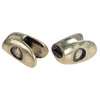



- 1
- 2
Tungsten, brass, glass or plastic?
Tungsten provides more mass than brass at a comparable external size. This lets a small nymph reach depth without an oversized head, but it also increases impact during casting and can overload a delicate hook. Brass produces a slower descent and is useful where the fly should remain lighter. Glass adds translucency and reflection; plastic builds colour and profile with little mass.
Material labels do not replace actual specifications. Wall thickness, hole size and shape change both mass and fit.
Tungsten beads
Use tungsten for fast water, deep presentation or compact patterns where the required weight must remain close to the hook eye. A smaller dense head can preserve the outline of a natural nymph. Check local rules and the rating of the rod and leader before casting heavily weighted rigs.
Brass beads
Brass is a practical choice for moderate depth, slower water and flies that should sink without dropping as aggressively. It is also available in many durable finishes. Do not infer exact mass from diameter alone; construction differs between series.
Glass and plastic beads
Glass can resemble an air bubble, translucent body segment or bright trigger point. Plastic beads add minimal weight and are useful where a coloured head is required without changing the fishing level substantially. Inspect the hole for sharp edges that could damage thread or the hook finish.
Regular, slotted and offset holes
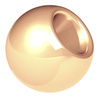
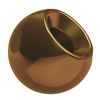
A regular drilled bead suits many conventional hooks when its hole passes the eye and bend. A slotted bead provides clearance around the angular bend of a jig hook and allows the heavier portion to sit in the intended orientation. Offset or specialist holes solve particular hook geometries.
A slotted bead will not fit every jig hook, nor does every slot fit every jig bend. Hook wire, barb, eye and bend dimensions vary. Dry-fit the exact components.
Shaped and articulated heads
Stonefly, caddis, fish and other shaped heads contribute recognisable profile as well as mass. Articulation beads and shanks connect moving sections of larger flies. Their opening, length and freedom of movement must suit the hook or wire system and leave no sharp edge against the connection.
Bead size and hook size
Published size charts are starting points. A bead must pass onto the hook, sit securely behind the eye and remain proportionate to the intended pattern. Too small a hole prevents assembly; too large a bead can slide over materials, crowd the eye or dominate the gape.
Build a test fly before preparing a full batch. Confirm that the hook point and gape remain effective and that the finished fly rides as intended.
Colour and finish
Natural black, copper and muted finishes integrate with the body. Gold and silver create a conventional metallic highlight. Fluorescent beads form a clear hot spot. Colour does not change the density of the base material, although coatings and construction can cause small mass differences.
Assembly
- Check the hole or slot for burrs.
- Pass the smaller opening over the hook eye where the design requires it.
- Guide the bead around the bend without forcing it.
- Seat slotted designs in the intended orientation.
- Build a thread or material dam behind the bead and secure it according to the pattern.
Do not force a bead with pliers. A cracked component or damaged hook is unreliable and can produce sharp fragments.
Frequently asked questions
Are slotted beads only for jig hooks?
They are primarily designed to clear specialist bends, especially jig hooks, but fit depends on exact geometry rather than the category name.
Can brass be used for nymphs?
Yes. It provides moderate weight and is often preferable when the fly should descend more slowly than a tungsten version.
Is a plastic bead necessarily buoyant?
No. Low density reduces added weight, but the buoyancy of the complete fly depends on the hook and all materials.